Northern Beaches
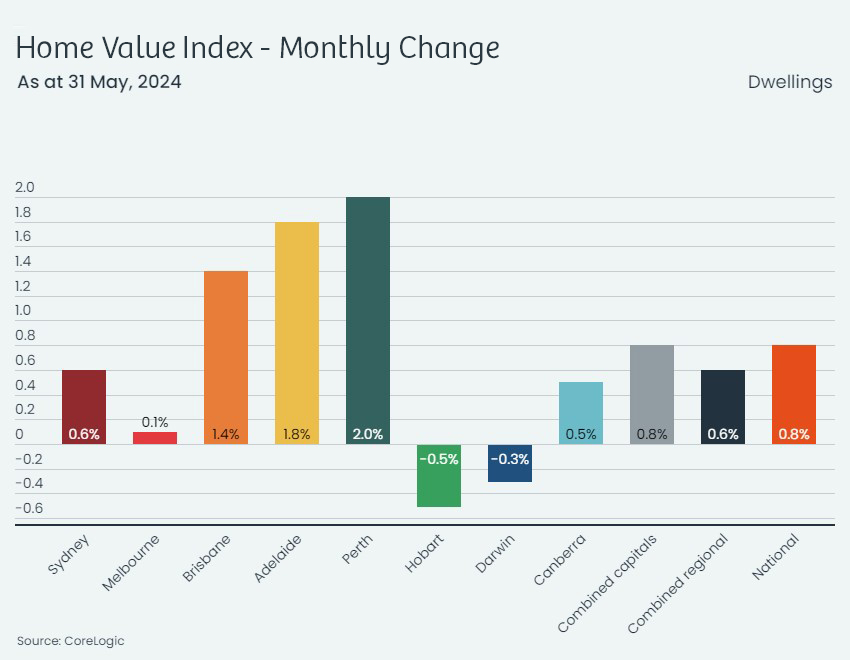
CoreLogic’s Home Value Index increased by 0.8% in May, marking the 16th consecutive month of growth and the largest gain since October. Leading the charge, Perth values rose by 2.0%, Adelaide by 1.8%, and Brisbane by 1.4%, each seeing a median dwelling value increase of over $12,000. Sydney's values grew by 0.6%, while Hobart and Darwin saw declines of -0.5% and -0.3%, respectively.
Tim Lawless of CoreLogic attributes this growth to extremely low supply in strong markets like Perth and Adelaide, where listings are more than 40% below the five-year average, and Brisbane, which is 34% below. These low inventory levels are driving rapid absorption of new listings, keeping stock levels low and prices high. Conversely, Hobart’s listings are 41% above the five-year average due to lower demand, with home sales 6.4% below the previous five-year average over the rolling quarter.
Sydney's market has reached a significant milestone, recovering to match the record high set in January 2022. After a -12.4% decline, Sydney’s values have rebounded with a 14.1% rise. Growth has been stronger in more affordable market segments, while the upper quartile values have seen a lower growth rate due to reduced borrowing capacity and affordability constraints.
In the past year, the upper quartile dwelling values across combined capitals increased by 6.7%, compared to a 13.4% gain in the lower quartile.
Brisbane has now surpassed Canberra as the second-most expensive capital city, with a median dwelling value of $937,479, a position it hasn't held since 1997. Brisbane's house values have also overtaken Melbourne’s median house value for the first time since 2008, standing at $937,479 compared to Melbourne’s $937,289. Since the onset of COVID-19, Brisbane’s values have increased by 59.8%, compared to Melbourne’s 11.2% and ACT’s 31.8%.